Your capability statement shouldn't describe the company you were three years ago.
Your past performance changed. Your capabilities changed. Your people changed. The customer changed. Your capability statement should too. Generate a current standard capability statement from your RFPeasy Company Profile, or tailor one specifically to the agency and opportunity you're pursuing. From Company Profile to finished Capability Statement, in Word and PDF.
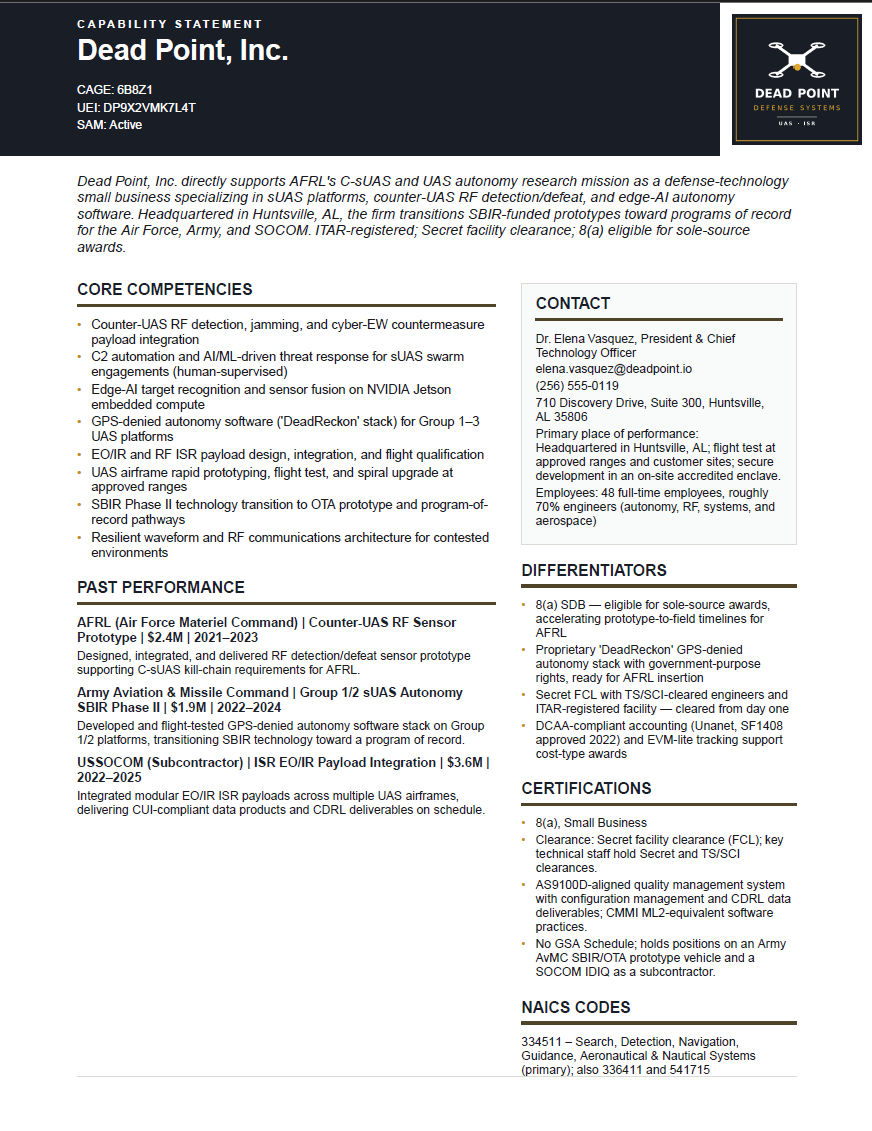
The Army capability statement sent to the Navy.
Old logo. Old past performance. Three-year-old employee count. NAICS codes nobody has checked recently. A core competency somebody wrote when the company had half its current capabilities. And somewhere near the top: "Supporting the United States Army…" Except this one is going to NAVSEA. Nobody intentionally sends a bad capability statement. It happens because the document became a template. And the template became: "Just use the last one."
"Just use the last one."
They have time. They're spent.
Capture touched it. BD touched it. Marketing changed the font. Operations updated the employee count. Someone asked whether that contract can be called past performance. The PM wants another differentiator. The CEO hates the spacing. Eventually: forget it, send the old one. That's the actual problem. Not laziness. Not incompetence. Too many hands, too many sources, too much friction for something everybody considers "just a capability statement."
The easiest document to reuse is often the document that should have been reconsidered.
"It's only an RFI."
"It's just Sources Sought."
"They're only doing market research."
"Nobody is evaluating this yet."
This is where companies start losing before there is anything to lose.
An RFI or Sources Sought isn't merely a paperwork event. It's often one of the first opportunities for the government to understand: Who can do this? Who has done it? Who appears credible? Who should we remember? A generic capability statement gives a program manager another document to process. A relevant one gives them a reason to stop.
The job isn't to prove you have a capability statement. The job is to make someone care about what's on it.
Stop rebuilding your company every time you need to describe it.
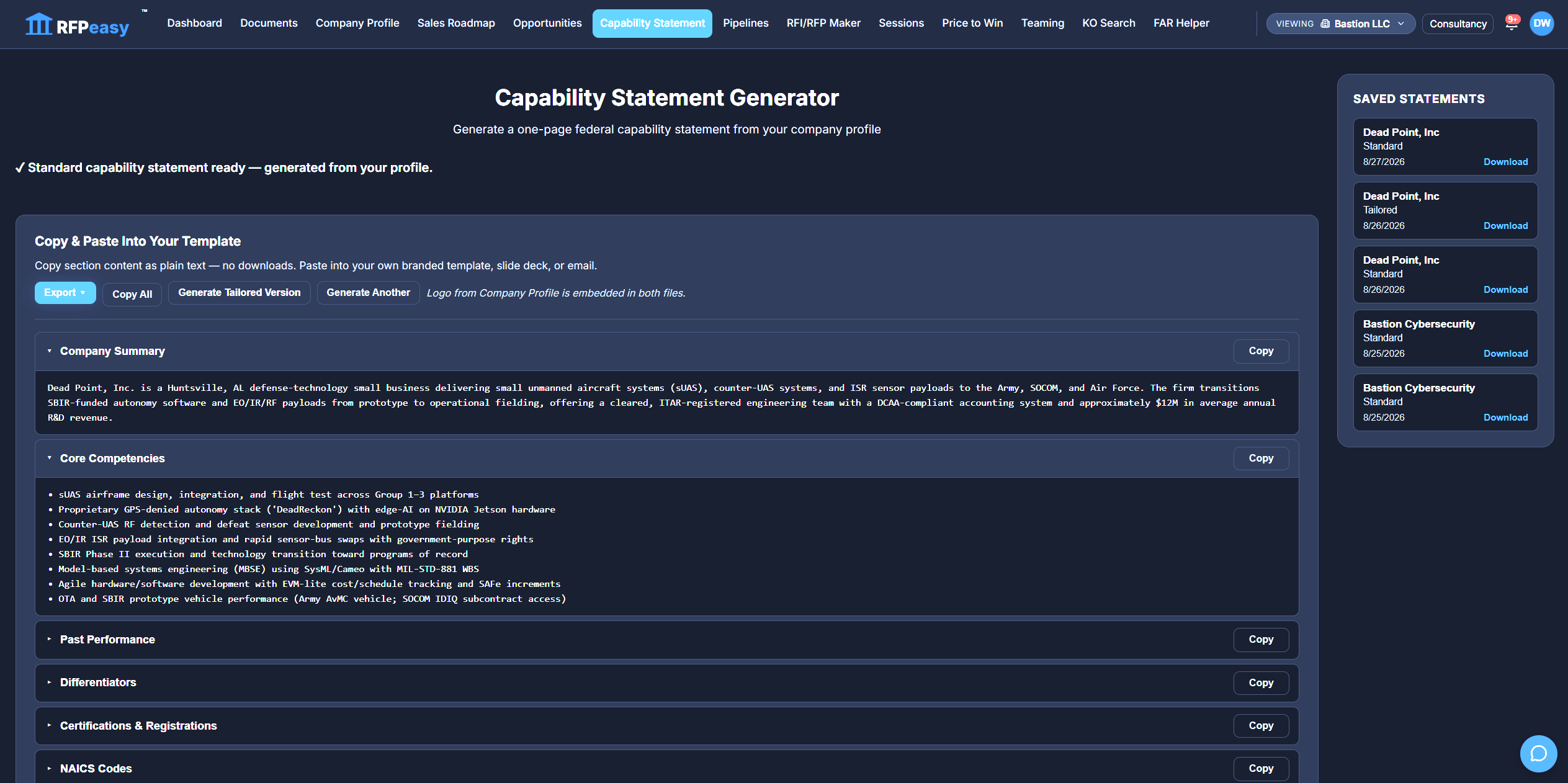
Your Company Profile already contains what the document needs: capabilities, past performance, differentiators, certifications, NAICS, PSC, company information, contacts, even your brand colors. RFPeasy assembles the statement from that source in the sections buyers expect: Company Summary, Core Competencies, Past Performance, Differentiators, Certifications & Registrations, NAICS Codes, Contact. And it refuses to invent: the generated narrative is checked against your profile, so a fact that is not in your company data does not appear on your company's document.
Change the source. Improve the output.
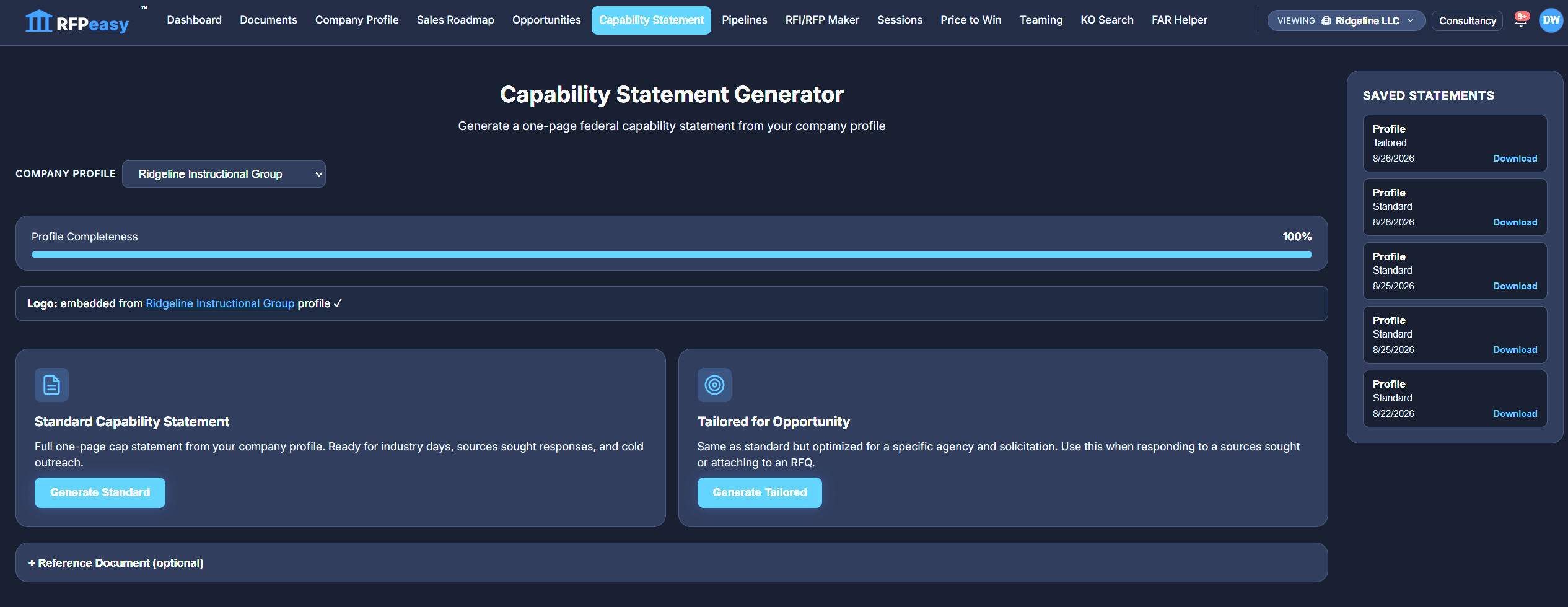
Sometimes you actually need the standard one.
Industry day. Networking event. Cold outreach. Teaming conversation. General introduction. That's fine. Generate the standard statement from the company's current profile instead of finding whatever PDF someone last edited.
Current capabilities. Current past performance. Current company.
Same company. Different conversation.
You're not changing who the company is. You're changing which parts of the company deserve emphasis for this customer. That's what good BD people already do manually. RFPeasy makes it repeatable: it asks for the Agency Name, Solicitation Title, PSC Code, and Set-Aside Type, optionally accepts a reference document, then emphasizes the past performance and capabilities that make you credible to that buyer.
USGS shouldn't get the same document as NAVSEA.
Are those even your NAICS codes anymore?
The capability statement says one thing. SAM.gov says another. The website has a third list. RFPeasy builds the statement from your profile's classifications, which creates something more useful than another field on a PDF: a reason to notice inconsistencies and fix the source, not just the document.
If your capability statement and federal registration tell two different stories, fix the source, not just the PDF.
RFPeasy doesn't lock the company inside the output.
Work section by section: copy an individual section into your own template, copy all, export the finished document, generate another, or generate a tailored version for the next customer. The platform handles assembly: reading your profile, drafting the competencies, formatting for federal standards, generating the PDF. Your team keeps the human work: review, refine, decide, send.
Generate the substance. Keep control of the presentation.
The real before / after.
- Find the last capability statement
- Ask who has the newest version
- Check past performance
- Ask Marketing to update it
- Change agency name
- Argue about layout
- Notice the NAICS might be wrong
- Send it anyway
- Select Company Profile
- Standard or Tailored
- Review
- Send
Stop recreating the business in every tool.
The statement is generated from the same source the rest of the platform runs on, and it stays attached to the pursuits it positions.
- Company ProfileEvery section is assembled from your profile answers: capabilities, past performance, certifications, codes and brand.
- KO SearchFound the buying office? Tailor the statement to that agency before you introduce yourself.
- Contract Monitor/PipelineLink the statement to the pursuit it positioned, so the record travels with the deal.
Don't send yesterday's company to tomorrow's customer.
Build the standard version when standard is appropriate. Tailor it when the customer matters. Keep the underlying company information current. Every industry day, RFI, Sources Sought, contracting officer, program manager, teaming partner, and cold introduction is positioning; your capability statement is a compressed argument for why your company belongs in the conversation.