Stop guessing where your federal market is
RFPeasy maps your entire market from USAspending (every award in your NAICS, not a sample), then deep-dives the largest contracts and turns it all into a slide deck built around your company. Where the money goes, who wins it, which offices buy, and where to focus next.
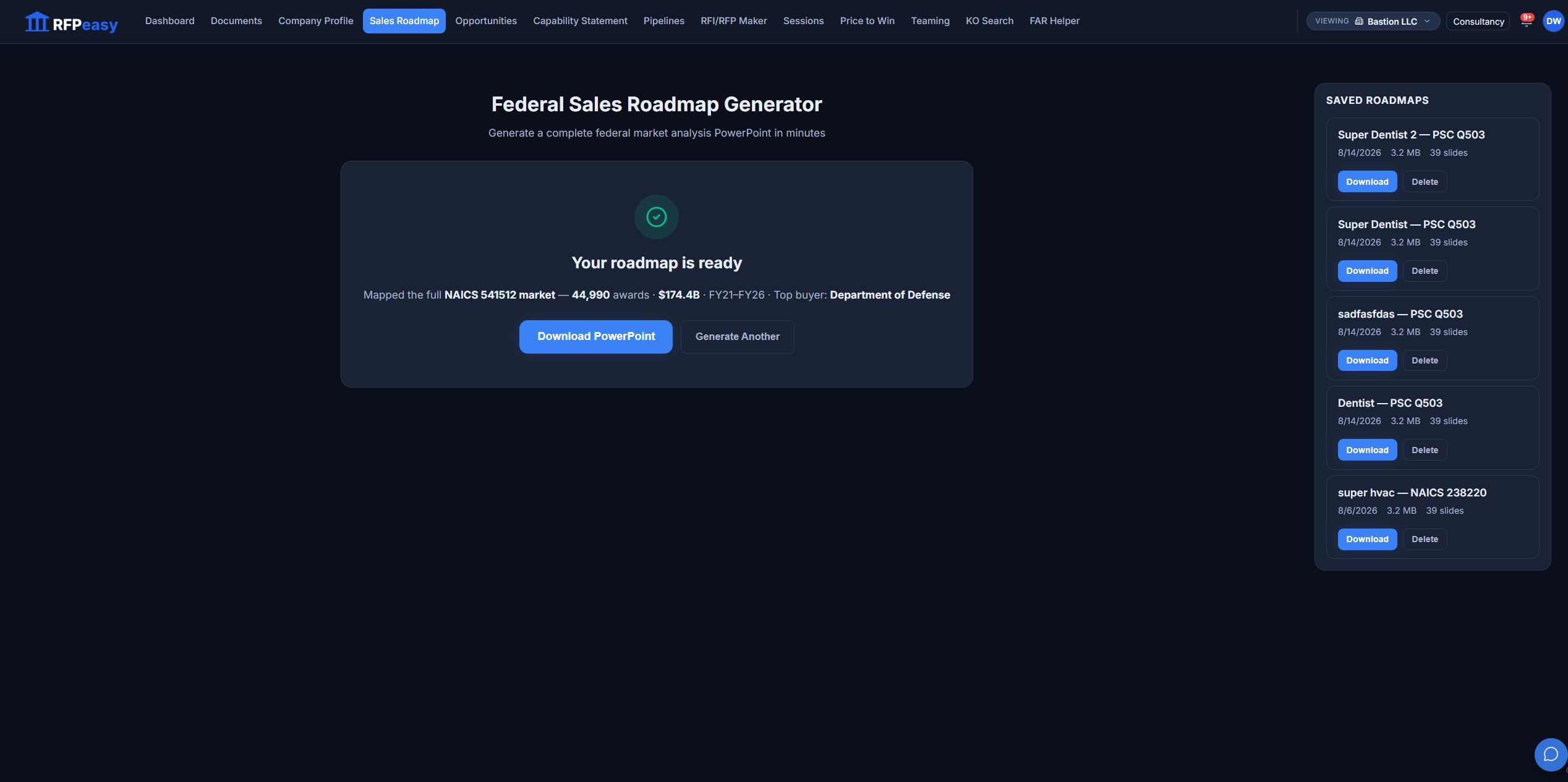
Most GovCon companies don't have a market strategy. They have a list of opportunities.
Who actually buys what we sell?
How much do they spend?
Which offices are buying it?
Who keeps winning?
What contract vehicles are being used?
What size contracts dominate this market?
Where are contracts approaching expiration?
Where does our past performance give us an advantage?
Your roadmap starts with you.
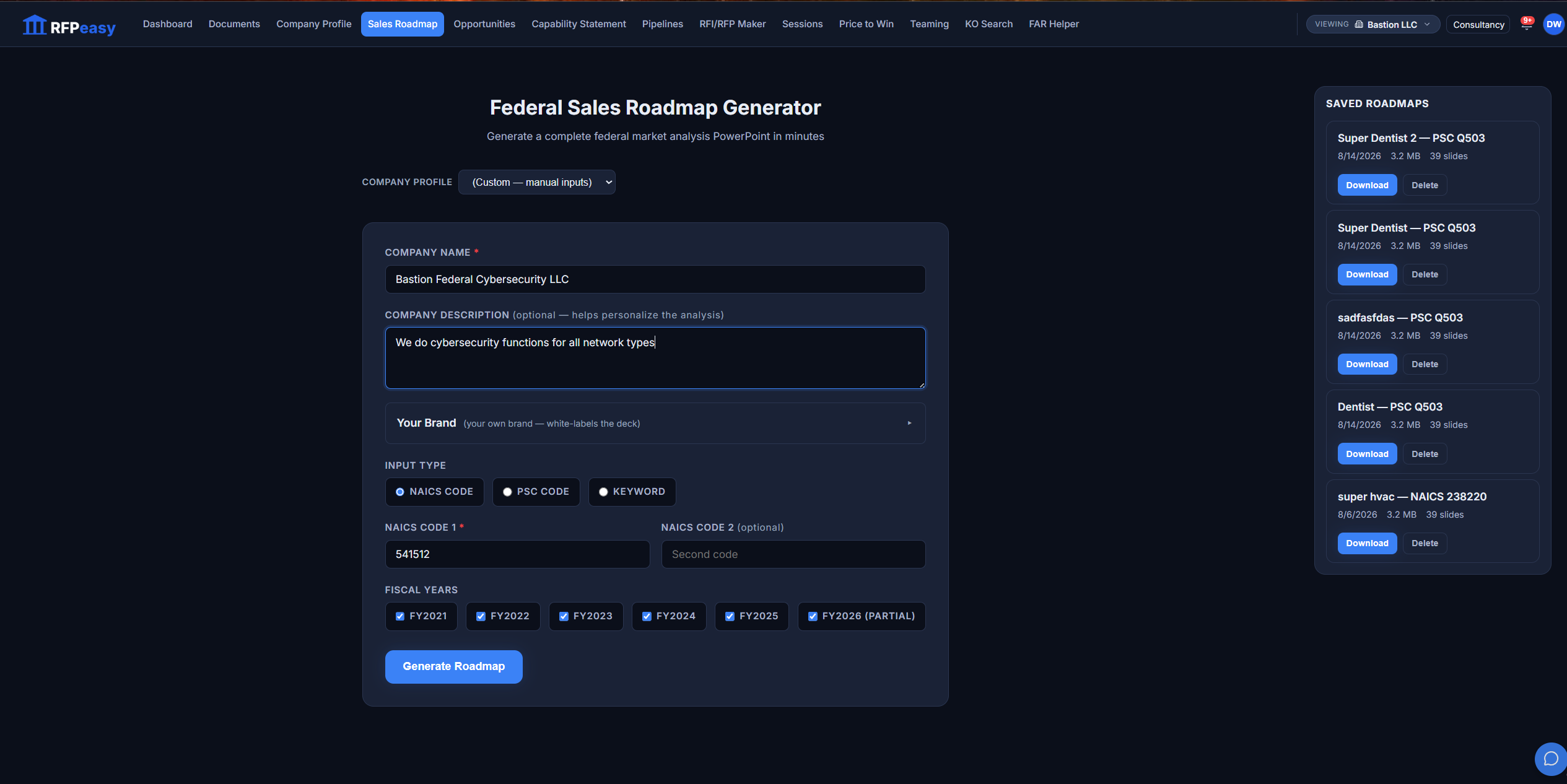
Pick a company profile and the run starts from the business you are trying to grow, or switch to manual inputs to explore a market you have not entered yet. Point it at a NAICS, a PSC, or plain keywords, choose the fiscal years, and set your own brand: the deck is white-labeled for whoever presents it.
Opportunity search tells you what's available. Market intelligence tells you where to build the business.
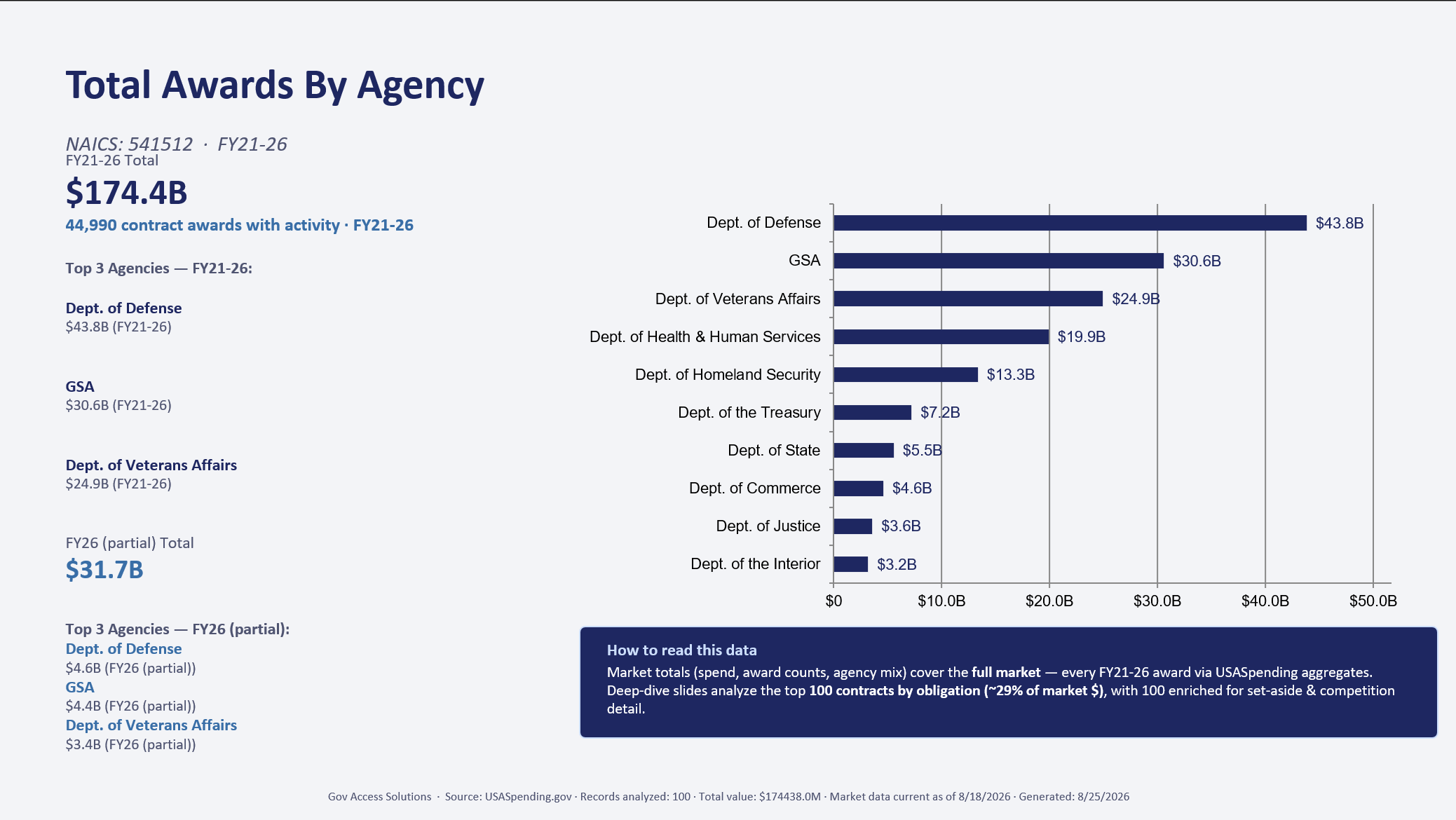
See where federal dollars are actually going.
A market can sound attractive and still be a poor place to spend limited BD resources. The deck opens the market by the numbers: total awards by agency, with the full-market dollar figure and where the spending concentrates. Instead of asking "Do agencies buy this?" start asking "Who buys it, how much do they spend, and where is that spending concentrated?"
Don't build a federal sales strategy around assumptions when the government already published the receipts.
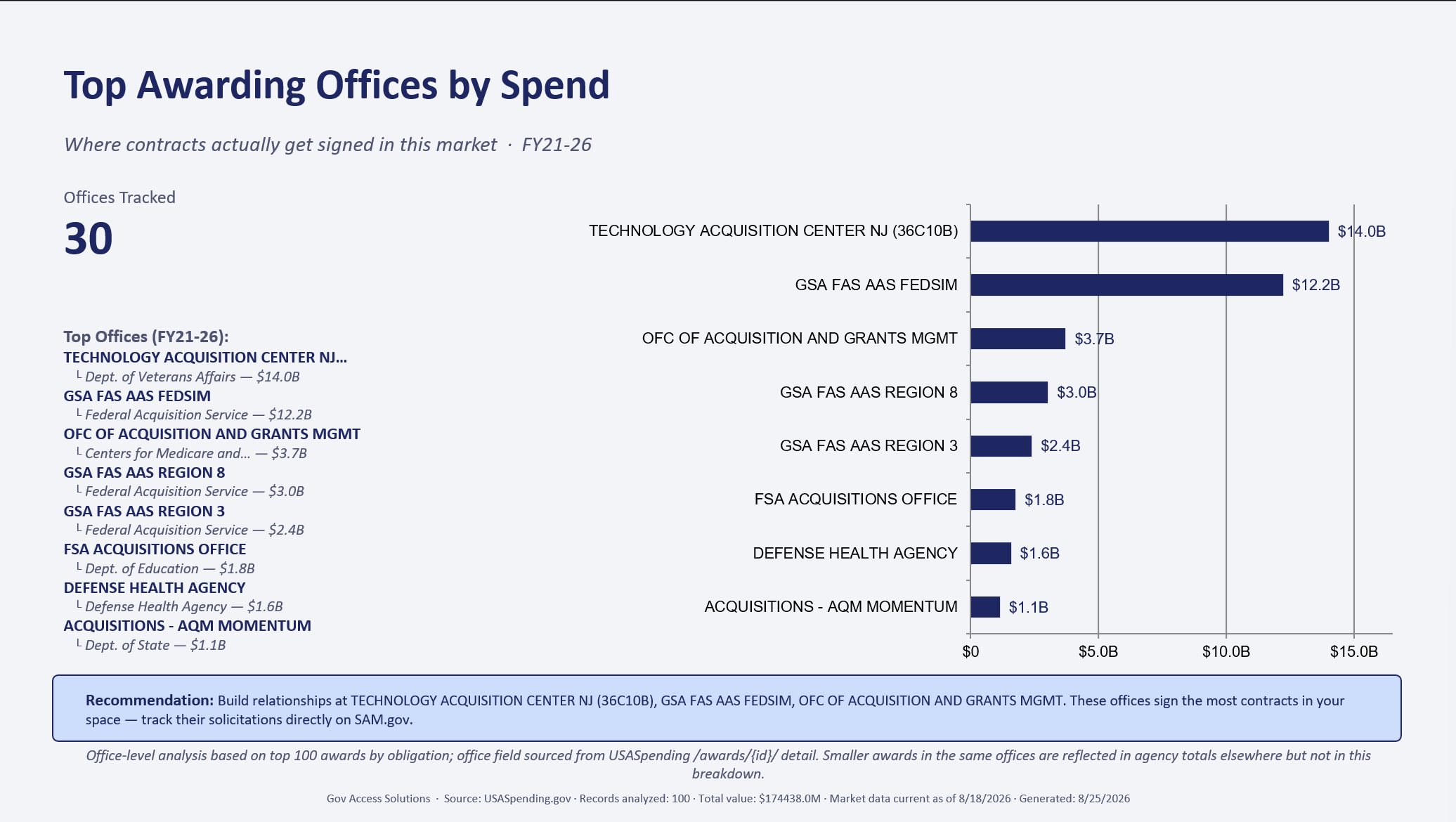
Find the offices actually buying what you sell.
Not every federal agency represents an equal market, and inside each agency, a handful of contracting offices place most of the awards. The deck ranks the top awarding offices by spend, so account planning starts from "Which offices have demonstrated that they buy this?" instead of "Which agencies should we call?"
You're not entering an empty market.
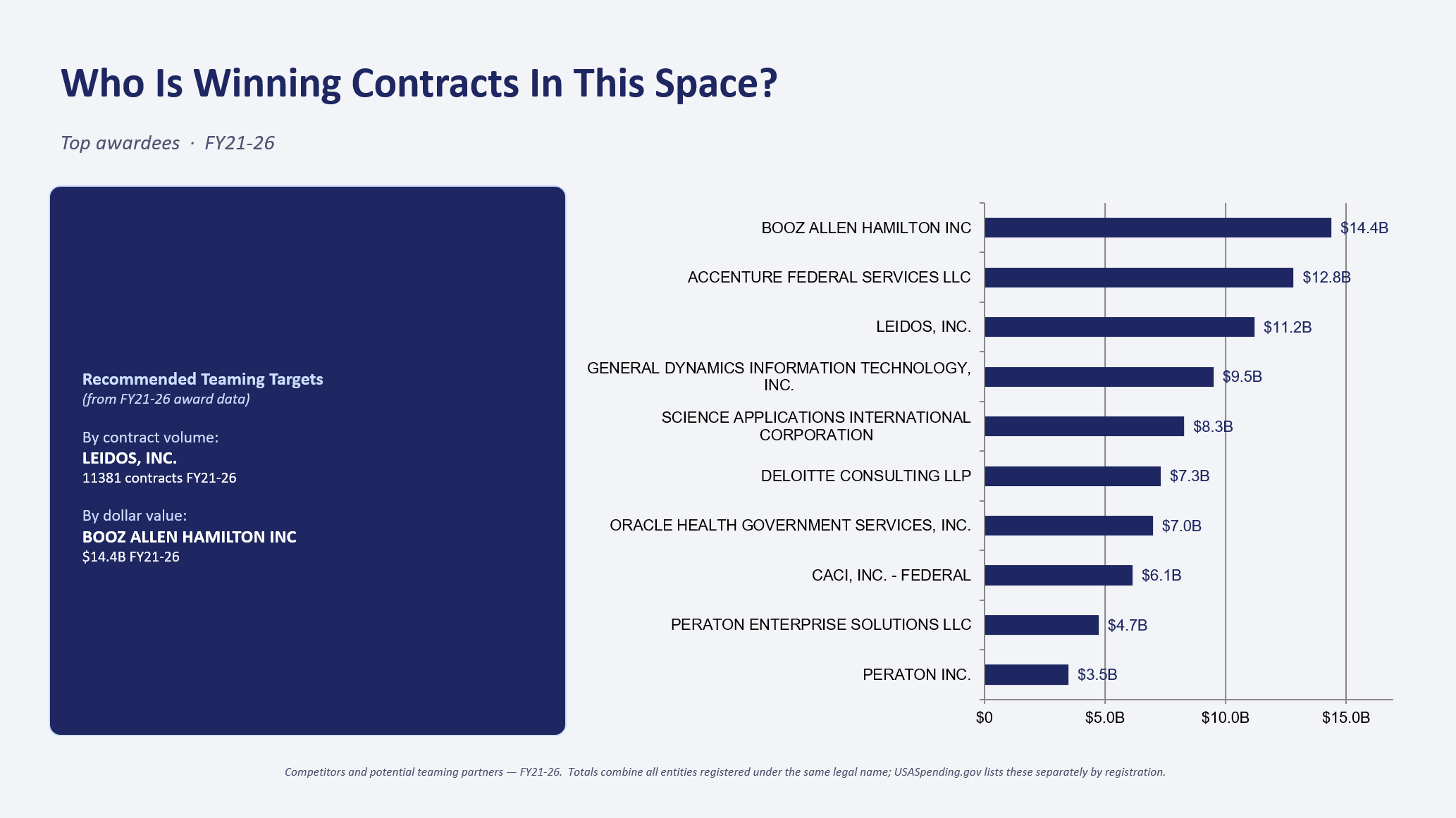
The deck names who is already winning (the top awardees by dollars and by contract volume) and goes a step further: it recommends teaming targets from the award data itself, the incumbent with the most contracts and the one with the most dollars. A company you assumed was a competitor might be the prime that brings you onto the work.
Know who you're competing against before you compete.
The best time to discover a recompete isn't when the RFP drops.
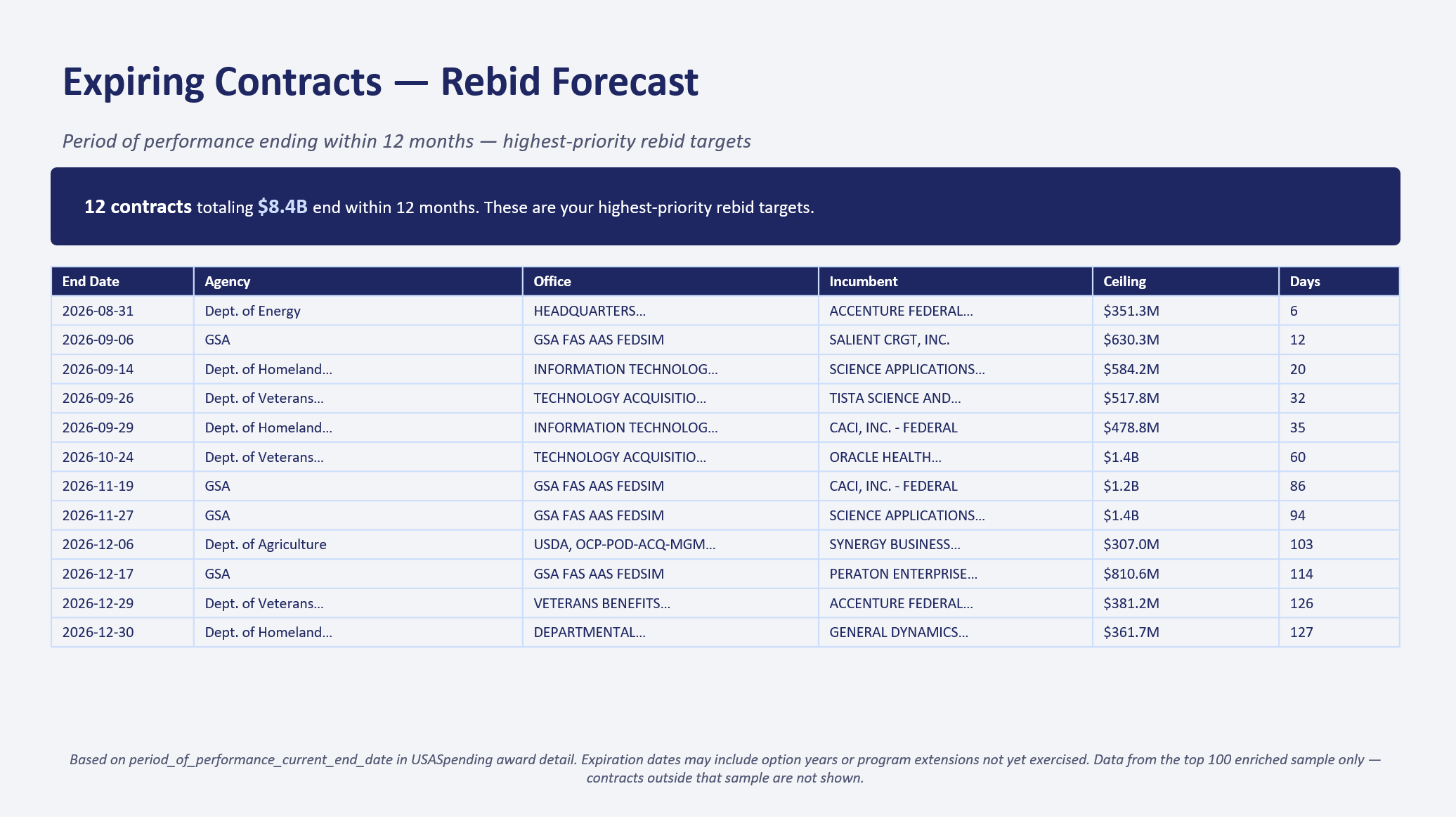
The Expiring Contracts (Rebid Forecast) slide lists the contracts in your market whose period of performance ends within 12 months (in the run shown, 12 contracts totaling $8.4B), each with its end date, agency, office, incumbent, ceiling and days remaining. That buys the one thing a database cannot: time to work the buyer before anything posts.
Earlier changes everything.
What the government buys matters. How it buys matters too.
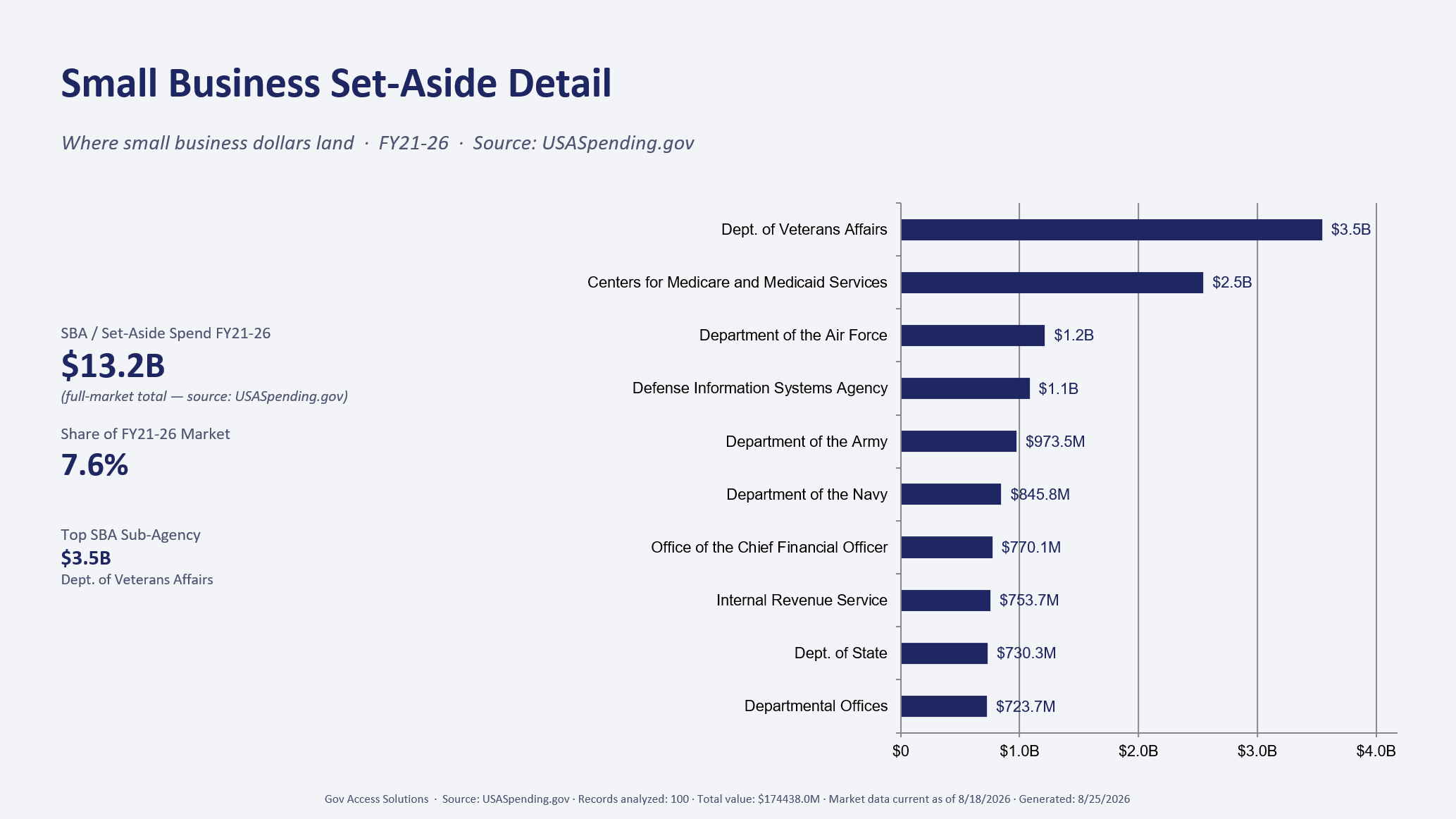
A market dominated by unrestricted full-and-open awards requires one strategy. A market with substantial small-business set-aside dollars creates another. The deck breaks down how your market buys (set-aside participation by agency among them) so you can decide whether to prime, subcontract, team, pursue a vehicle, or spend your resources somewhere else.
Data isn't the deliverable. Decisions are.
Where do we compete?
Which agencies deserve dedicated attention?
Which incumbents should we understand?
Which contracts should we start tracking?
Where should we build relationships?
Where might we need teaming partners?
What should BD do next?
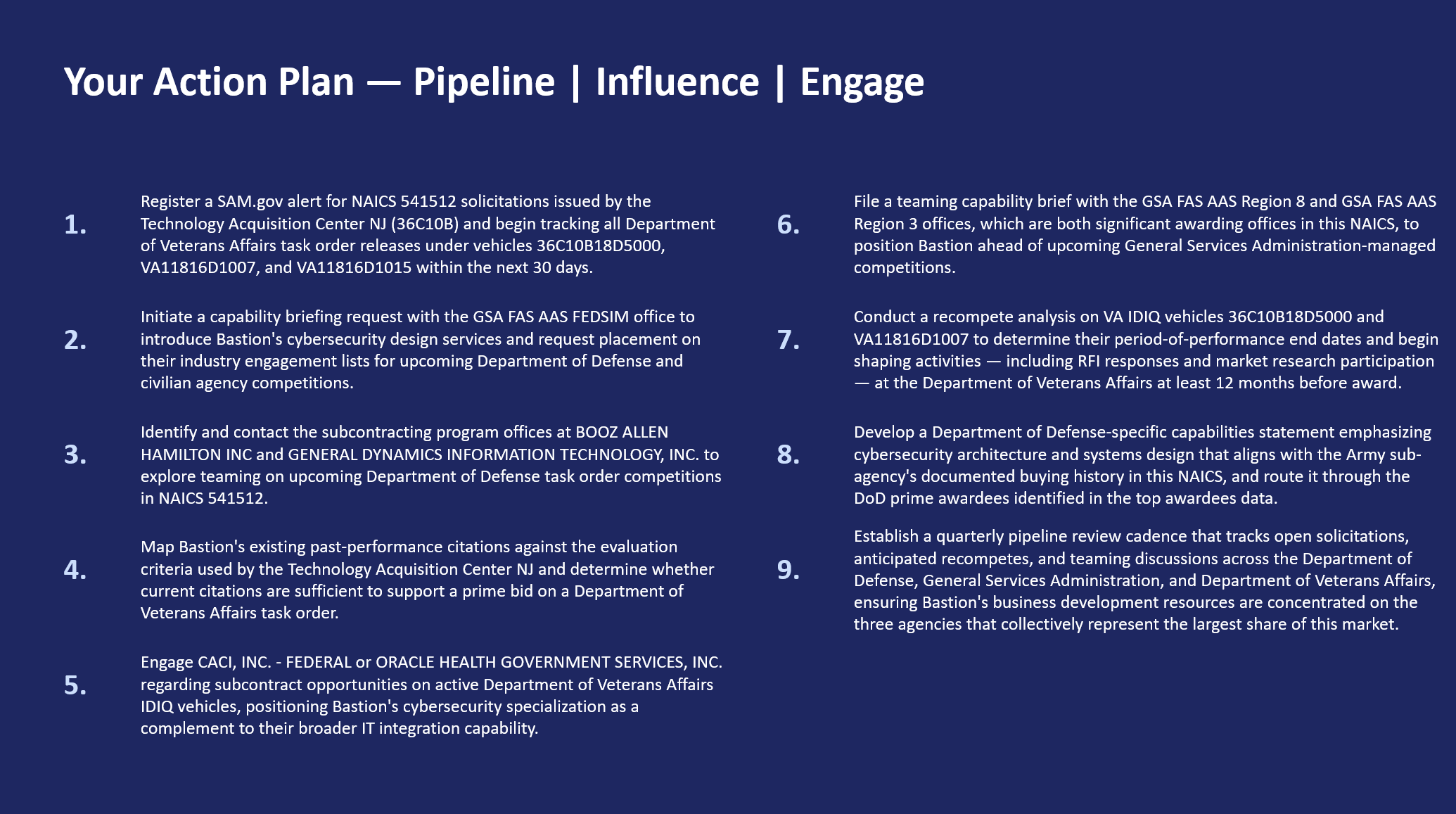
The deck ends by telling you what to do Monday morning.
The final slide is an action plan built from your market's own data. Nine numbered moves across Pipeline, Influence and Engage: register the SAM alert, request the capability briefing, contact the named subcontracting offices, run the recompete analysis, set the review cadence.
Leave with the analysis.
Most federal BD platforms are built around access to information. RFPeasy is built around producing an artifact from that information: a complete, presentation-ready PowerPoint (the saved runs shown on this page are 39 slides each) mapping the full market from USAspending aggregates, with deep-dive slides built on the top 100 contracts by obligation, and every slide footed with its record counts so the methodology travels with the deck.
Research you can actually use, and hand to a board.
Good market research isn't difficult because the data doesn't exist. It's difficult because somebody has to do the work.
- Search USAspending.
- Build the filters.
- Export the awards.
- Clean the data.
- Identify agencies.
- Calculate spending.
- Research contractors.
- Analyze contract values.
- Look for patterns.
- Identify expiring work.
- Turn everything into charts.
- Build the deck.
- Interpret what it means.
- Then repeat it when the market changes.
- RFPeasy generated the roadmap.
- Your team decides what to do with it.
Watch the analysis assemble itself.
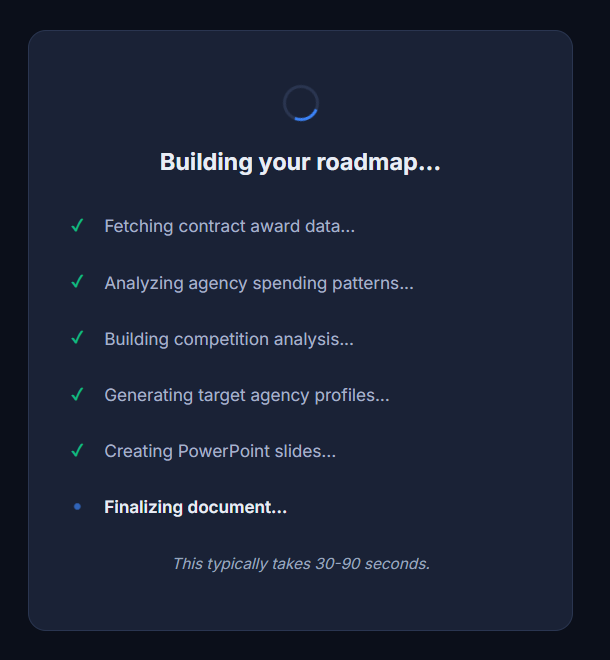
Kick off a run and the stages check off as they finish: fetching award data, analyzing spending patterns, building the competition analysis, generating agency profiles, creating the slides. A run typically takes 30–90 seconds, and the finished deck lands in Saved Roadmaps.
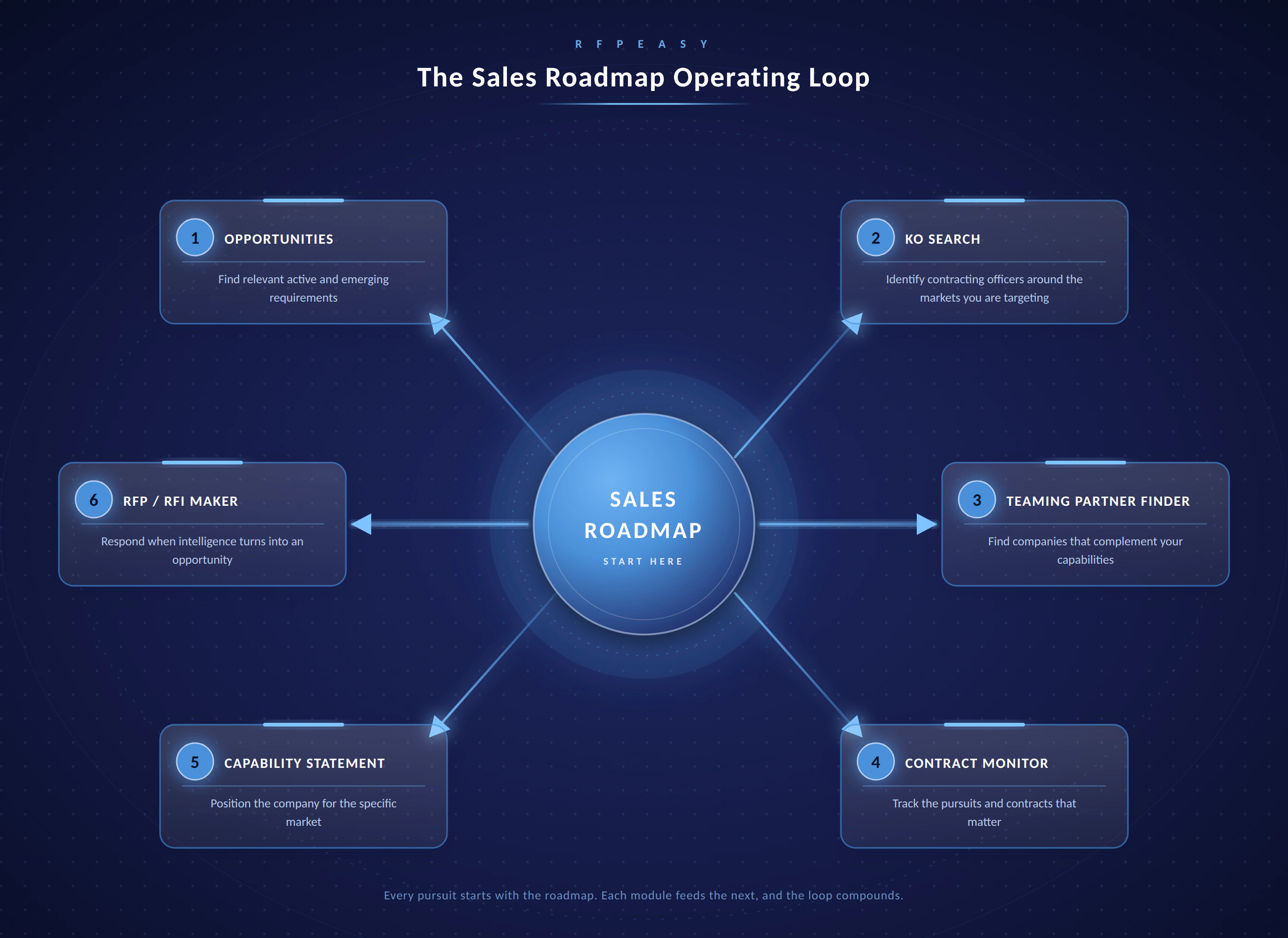
The roadmap is the center of the loop, not the end of it.
One market analysis feeds six working tools: Opportunities, KO Search, Teaming Partner Finder, Contract Monitor, Capability Statement and the RFP/RFI Maker. Every pursuit starts with the roadmap; each module feeds the next, and the loop compounds.
Once you know where to compete, go compete there.
The roadmap shouldn't become a PDF sitting in a folder. It tells you where to go; the rest of RFPeasy is how you work the market once you get there.
- Company ProfileYour company name and primary NAICS seed each run, so the analysis starts from your business.
- OpportunitiesWork the markets the deck names in your live matched feed.
- KO SearchThe deck ranks the buying offices; KO Search finds the officers inside them.
- TeamingTake the recommended teaming targets into a real partner search.
- Contract Monitor/PipelineTrack the rebid-forecast contracts as pursuits before they post.
- Capability StatementPosition the company for the specific market the deck told you to enter.
Large contractors have people doing this already.
Competitive intelligence teams. Market researchers. Capture analysts. Data subscriptions. Small and medium businesses usually don’t lack the need for that intelligence; they lack the capacity to continuously produce it. RFPeasy changes the economics of getting the analysis, so your people spend their time on the things software can’t replace: building relationships, talking to customers, developing partners, making pursuit decisions, winning.
Your next opportunity shouldn't be the beginning of your strategy.
Know the market before the solicitation arrives. The full market mapped from real award data. One clearer view of where to compete.